 The Department for Education’s consultation, Adoption Support that Works for All, set an important ambition: to improve outcomes for adopted children and their families. At The Belay Foundation, we share that goal. But based on our experience working directly with families, we believe the current proposals fall significantly short of what is needed.
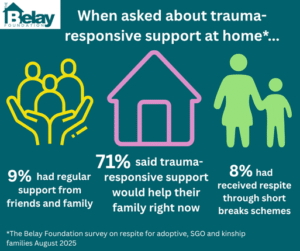
Our response is rooted in what families tell us every day. Parents are not failing because they lack training or peer support. They are exhausted, often isolated and frequently navigating systems that do not understand their children’s needs. Many are already at or near crisis long before meaningful help arrives.
We set out four essential pillars that must underpin any effective adoption support system.
First, a whole-family approach. Children’s recovery from early trauma depends on stable, attuned relationships. That means supporting parents’ mental health and capacity as a core part of the system – not an afterthought.

Second, trauma-responsive in-home relational support. Our work shows that consistent, attachment-focused and trauma-responsive support within the home can transform family stability. This is not a luxury – it is often the difference between families coping and breaking down.
Third, financial stability. Many adoptive and kinship families face significant financial strain due to reduced employment and increased costs. Without addressing this, other forms of support are undermined.
Fourth, a supportive social environment. Schools, health services and community services must understand trauma and neurodiversity. Families cannot carry this responsibility alone.
We assessed the consultation’s eight proposals through this lens and disagreed with all of them in their current form:
- The proposed baseline parenting support offer places too much emphasis on training without addressing whether families have the capacity to engage. Without practical support like in-home respite, many simply cannot attend or implement what they learn.
- We welcome the idea of proactive support at key life stages, but the proposal focuses too narrowly on parents, rather than requiring systems like schools and employers to adapt as well.
- Similarly, the focus on peer and community support risks over-relying on already burnt-out parents. Peer support matters – but it cannot replace skilled practical help.
- We welcome the idea of proactive support at key life stages, but the proposal focuses too narrowly on parents, rather than requiring systems like schools and employers to adapt as well.The concept of enhanced support plans is positive, but without funding, accountability and multi-agency responsibility, plans risk becoming another burden rather than a solution.
- We support standardised needs assessments in principle, but they must go beyond the child to include parental burnout, financial stress and wider family context – and crucially, they must lead to actual support.
- On evidence standards, we caution against frameworks that exclude innovative, non-clinical interventions like in-home support. These approaches need space to develop alongside more established therapies.
- We strongly oppose the proposed devolution of funding without safeguards. Without a nationally ring-fenced fund and clear entitlements, families risk facing a postcode lottery in accessing support.
- Finally, the approach to value for money is too narrow. True value lies in preventing crisis, placement breakdown and long-term costs – not just reducing short-term spend.
In summary, we support the government’s ambition – but not the current approach. Adoption support will only “work for all” if it recognises that family stability depends on practical, relational and financial support, backed by strong national funding and accountability. With the right changes, this could be a transformative moment. Without them, too many families will continue to struggle alone.
Our full response is available here.